 Save
Save I still remember the first time I arranged a Star of David salad on my grandmother's old ceramic platter during a Hanukkah dinner. The kitchen was warm with the smell of latkes frying, and I was nervous about getting the angles just right. But as I laid out those first cucumber slices, something magical happened—the geometric pattern began to emerge, and suddenly I wasn't just making a salad. I was creating edible art that celebrated everything we were gathering to honor. Now, whenever I make this dish, that same sense of wonder returns, and I find myself working a little slower, wanting to share that moment with everyone at the table.
I learned the power of this salad's presentation at a dinner where my sister's five-year-old daughter pointed at the star and shouted, "Look, it's a real star on our table!" That single moment made every minute of careful arrangement worth it. Now I know that food arranged with intention becomes something more than sustenance—it becomes memory.
Ingredients
- Baby spinach and arugula: These form your verdant foundation, and I've learned that washing and thoroughly drying them hours ahead prevents any watery pooling. The peppery arugula adds a subtle bite that balances the rich feta beautifully.
- Cucumbers: Slice them thin—almost translucent—so they stay tender and create clean, crisp lines for your triangles. I always use English cucumbers because they have fewer seeds and slice more elegantly.
- Cherry tomatoes: Their natural sweetness is what makes people reach back for seconds. Halving them reveals their jewel-like interior and helps them nestle into the design without rolling.
- Bell peppers, yellow and red: These are your color story. The contrast between them makes the star visually pop, and I've found that cutting them into thin strips rather than chunks helps them conform to the geometric structure.
- Purple cabbage: This adds a subtle earthiness and a gorgeous deep color that anchors the design. It's surprisingly sturdy, which means it holds its shape beautifully throughout the evening.
- Red onion: Just a whisper of it—optional, yes, but it adds a sharp, bright note that cuts through the richness of the cheese and oil if you're brave enough to include it.
- Feta cheese: Crumbled by hand rather than pre-crumbled, it holds its shape better and feels more intentional scattered across the points of the star.
- Kalamata olives: These briny little gems provide a salty counterpoint and authentic Mediterranean flavor. Halving them helps them distribute more elegantly across the design.
- Capers: Tiny but mighty, they add a tangy punch and feel somehow festive scattered along the star's edges.
- Pine nuts: Toasted just before you assemble, they add warmth and a subtle richness. I toast mine in a dry skillet for exactly two minutes—any longer and they turn bitter.
- Olive oil, lemon juice, and red wine vinegar: This is the dressing's backbone, and I keep it simple because the vegetables deserve the spotlight. The brightness of fresh lemon juice makes all the difference—never use bottled.
- Honey and Dijon mustard: A teaspoon of each creates subtle depth and helps the dressing emulsify, creating a silky coating rather than a thin wash.
Tired of Takeout? 🥡
Get 10 meals you can make faster than delivery arrives. Seriously.
One email. No spam. Unsubscribe anytime.
Instructions
- Prepare your canvas:
- Use your largest, most beautiful platter—this salad deserves a stage. Make sure it's completely clean and dry. I like to set it on the counter a few minutes before I begin so I can step back and see how the light hits it.
- Lay your greens:
- Spread the spinach and arugula in a thin, even layer across the entire platter, leaving no gaps. This is your foundation, and it should feel cushioned and green, like a spring meadow. Don't press down; just gently spread.
- Map your star:
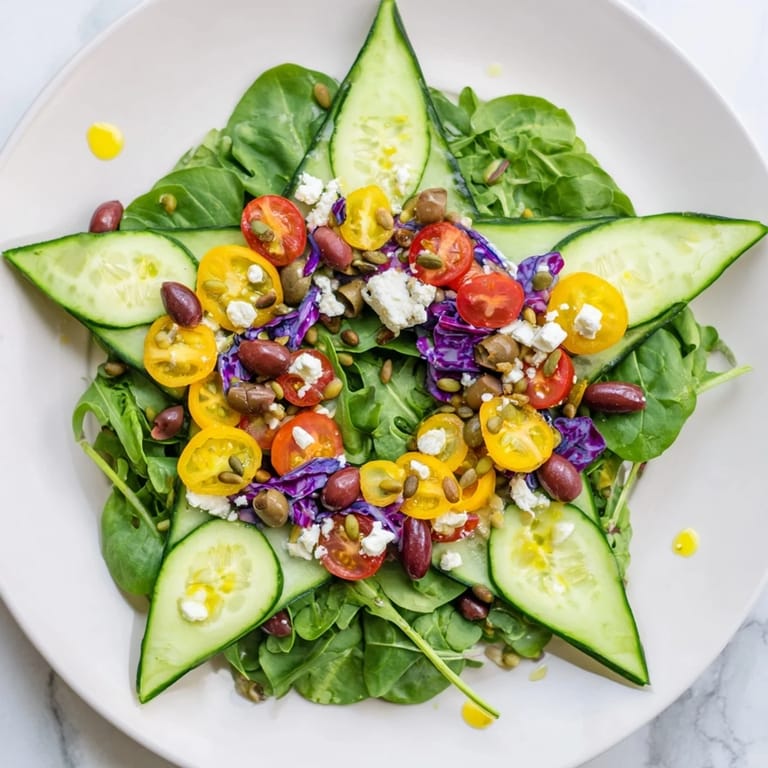
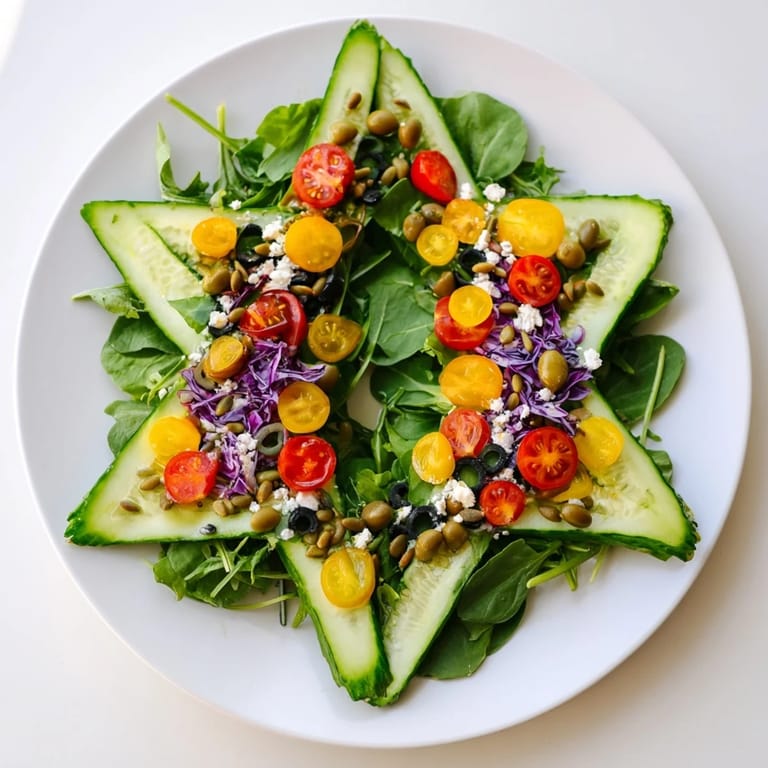
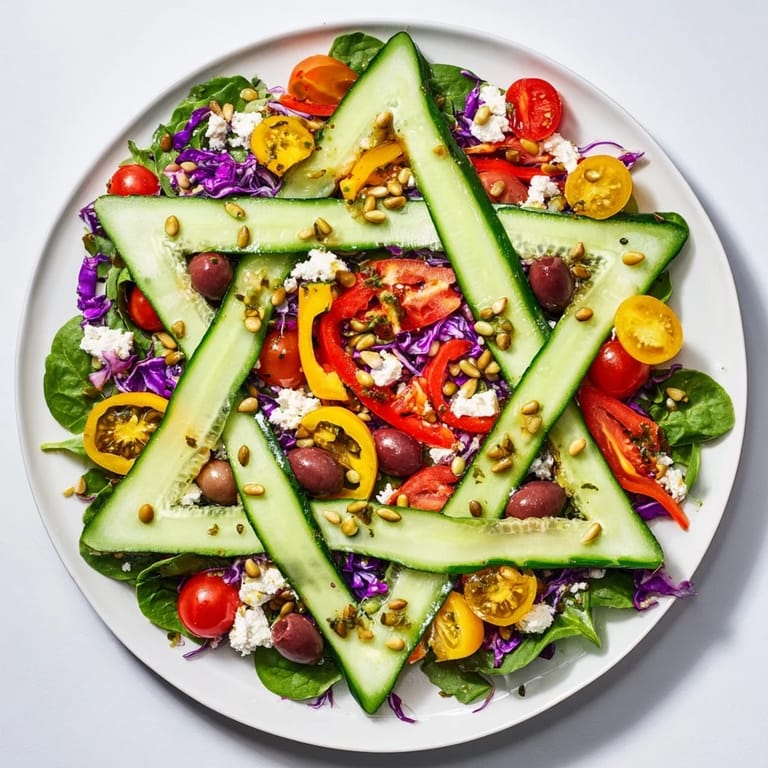
- Now comes the geometry. Picture two overlapping equilateral triangles—one pointing up, one pointing down. Using your thinly sliced cucumbers, outline these triangles directly on the greens. Work slowly. Step back frequently. If the angles feel off, adjust. This is about creating something beautiful, not being perfect.
- Fill the triangles:
- Within each triangular section, create distinct regions of color and flavor. One section becomes a bed of halved cherry tomatoes, their cut sides facing up like little rubies. Another fills with yellow pepper strips in neat rows. Another celebrates the red pepper. Use the purple cabbage to create bold color blocks. Think in terms of color harmony—each section should contrast beautifully with its neighbors.
- Adorn the edges:
- Now scatter your feta cheese along the points of the star and around its perimeter. Add the halved Kalamata olives in clusters. Sprinkle the capers where they catch light. Scatter the toasted pine nuts as the final flourish. This is where precision gives way to artistic instinct.
- Make the dressing:
- In a small bowl, whisk together the olive oil, lemon juice, and red wine vinegar. Add the honey, Dijon mustard, salt, and pepper. Whisk until it comes together into something cohesive and glossy. Taste it—the acidity should be bright but balanced.
- The final moment:
- Just before your guests arrive, drizzle the dressing evenly across the salad using a gentle hand. Or, if you'd prefer to keep the presentation pristine longer, serve the dressing on the side in a small bowl with a spoon, letting each person customize their portion.
- Bring it to the table:
- Carry it with both hands. Present it. Let people take a moment to really see it before they taste it. This small pause honors the effort and creates that magical moment when a dish becomes a memory.
 Save
Save There's a particular kind of pride that comes from creating something beautiful that people want to pause and admire. At one celebration, a guest asked if she could wait to eat it because she wanted to finish photographing it first. I realized then that this isn't just food—it's a way of showing love through presentation.
The Geometry of Flavor
Creating the perfect Star of David requires thinking about not just how things look, but how the flavors balance as you move across the platter. I've learned that placing delicate cucumber slices next to bold purple cabbage creates a visual pause that naturally leads the eye around the design. The salty feta and briny olives at the points of the star act as anchor flavors—places where your fork naturally lands first, awakening your palate for the fresher vegetables. This isn't accidental design; it's thoughtful composition that makes the eating experience as intentional as the looking.
Make It Your Own
While the classic version is stunning on its own, I've discovered that this salad invites personalization. Some seasons I add thin slices of radish for peppery crunch. Other times, I scatter fresh herbs like dill or mint across the finished platter just before serving, adding a whisper of something green and fragrant. If you're serving this to guests with varying dietary needs, the modular nature of the salad makes it easy—just adjust the proteins, cheese, and nuts according to what people can eat, and the visual impact remains.
Serving Suggestions and Pairings
This salad shines alongside warm pita bread or crispy matzo, giving people something to do with their hands and adding textural contrast. I've found that it pairs beautifully with other Hanukkah dishes—the bright acidity of the lemon dressing cuts through the richness of potato latkes and makes you hungry for another bite. It also stands alone as a light lunch, especially in warmer months when heavier food feels too much.
- Serve it with the dressing on the side for a longer-lasting presentation, or drizzle it just before eating for maximum flavor absorption
- Have extra napkins nearby—the drizzle of oil adds richness but also means clean hands are part of the dining experience
- Remember that this salad is best eaten at room temperature or just slightly chilled, not ice-cold, so it can deliver its full flavor
 Save
Save This salad has taught me that the most meaningful recipes are the ones where presentation and flavor dance together as equals. Every time I arrange these vegetables into a star, I'm reminded that cooking for others is an act of care that begins long before anyone takes a bite.
Recipe FAQs
- → What ingredients create the star shape?
Thin cucumber slices outline two overlapping equilateral triangles, forming the six-pointed star structure on the platter.
- → How is the salad dressed?
A bright dressing made with extra virgin olive oil, lemon juice, red wine vinegar, honey, Dijon mustard, salt, and pepper is whisked and drizzled over the salad just before serving.
- → Can this salad be adapted for vegan diets?
Yes, substitute the feta cheese with a vegan alternative to maintain the rich, tangy flavor without dairy.
- → What garnishes add texture and flavor?
Toasted pine nuts, Kalamata olives, and optional capers provide crunchy texture and briny accents to the dish.
- → Is this dish suitable for special occasions?
Absolutely. Its artistic presentation makes it ideal for festive gatherings, especially Hanukkah or Mediterranean-themed celebrations.
- → Can protein be added to this salad?
Yes, cooked chickpeas or grilled chicken strips can be scattered within the star for added protein if desired.