 Save
Save I discovered the Fibonacci Fan Salad while scrolling through a museum gift shop catalog at an odd hour, mesmerized by photographs of mathematical patterns in nature. The spiral captured something I'd been chasing in my kitchen for months: how to make food that stops people mid-conversation, not because it tastes revolutionary, but because it asks them to pause and really look. That evening, I started arranging greens on my biggest platter, and something clicked—the spiral wasn't just pretty; it actually made the salad taste better because every forkful contained a different balance of flavors.
I made this salad for my partner on a random Tuesday when we were both tired and the fridge felt sparse. They looked at the platter and actually gasped, which never happens over food in our house. We sat on the back step eating in silence for a moment, and I realized that sometimes the presentation itself becomes part of the memory—it made an ordinary dinner feel intentional and a little bit magical.
Ingredients
- Baby spinach leaves: The tender base layer that wilts slightly when you drizzle warm dressing, so don't skimp on freshness here.
- Arugula: Brings a peppery bite that keeps the salad from feeling too delicate or one-note.
- Cherry tomatoes, halved: Their natural sweetness balances the greens, and halving them ensures you get tomato in every bite.
- Cucumber, thinly sliced: The cooling element that reminds your palate you're eating something light and alive.
- Radishes, thinly sliced: A secret weapon for crunch and a slight spice that nobody expects.
- Red onion, finely sliced: Use a sharp knife and slice paper-thin so the raw bite integrates rather than dominates.
- Avocado, sliced: Add this at the last possible moment or it will brown; slice it as you're walking to the table if you're worried.
- Blueberries: The unexpected flavor that makes people ask what they just tasted; they're not just decorative.
- Toasted walnuts, chopped: Toasting them yourself makes all the difference—the warmth brings out an almost buttery note.
- Crumbled feta cheese: The salty punctuation mark that ties all the sweet and bitter elements together.
- Extra-virgin olive oil: Quality matters here since the dressing is simple and straightforward.
- Lemon juice: Freshly squeezed, never bottled—the brightness is essential.
- Honey: Just a touch to round out the acid and mustard without making it sweet.
- Dijon mustard: Creates an emulsion that helps the dressing cling to the leaves instead of pooling at the bottom.
Tired of Takeout? 🥡
Get 10 meals you can make faster than delivery arrives. Seriously.
One email. No spam. Unsubscribe anytime.
Instructions
- Start with your foundation:
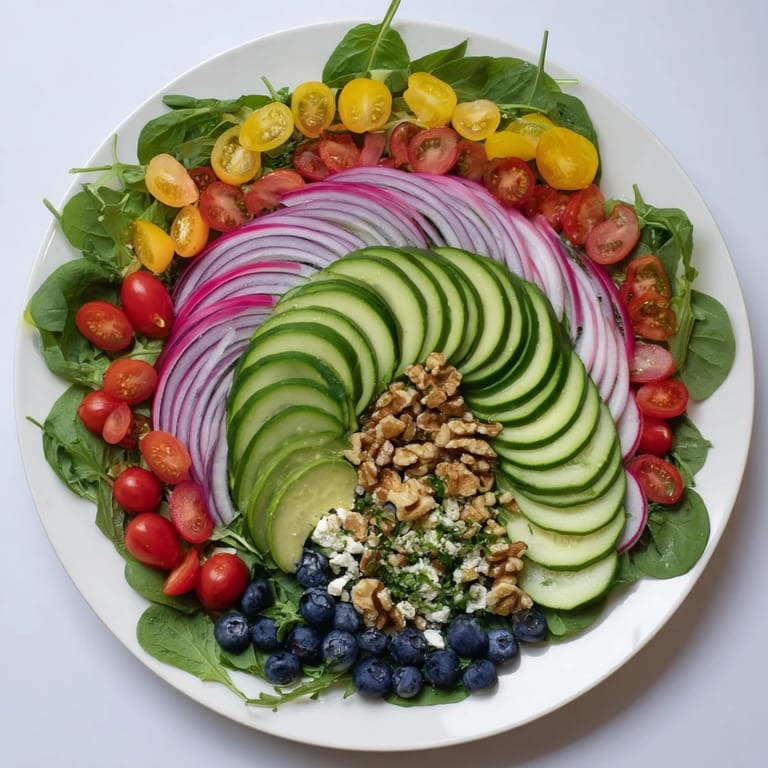
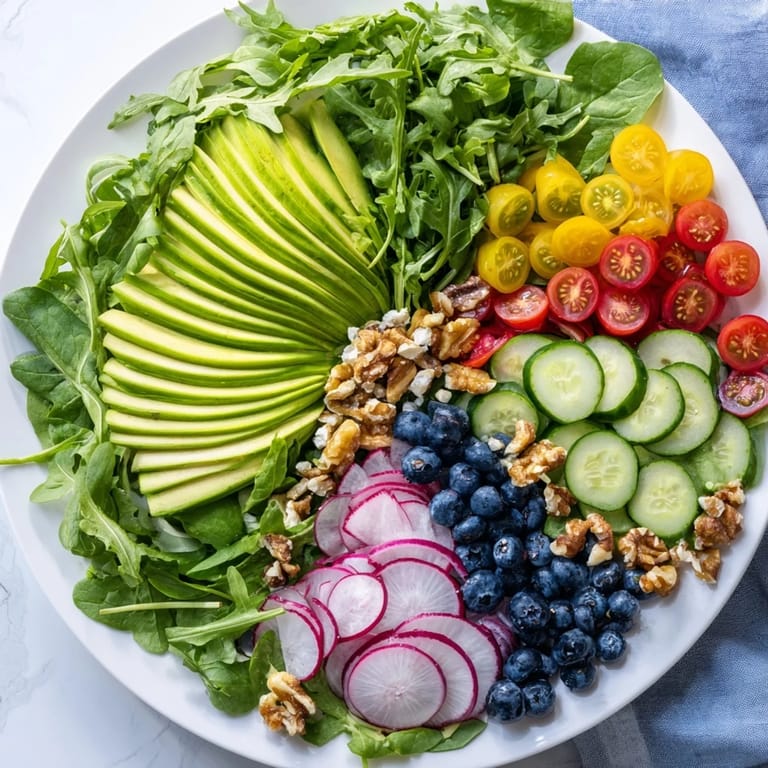
- Arrange the spinach leaves on your largest round platter in a crescent shape, creating the innermost arc of your spiral. They should overlap slightly, like roof tiles, and form a comfortable base.
- Build your first ring:
- Layer the arugula in a fan pattern overlapping the spinach, expanding outward and following an invisible spiral. You'll feel the rhythm of it after the first few leaves.
- Continue the spiral:
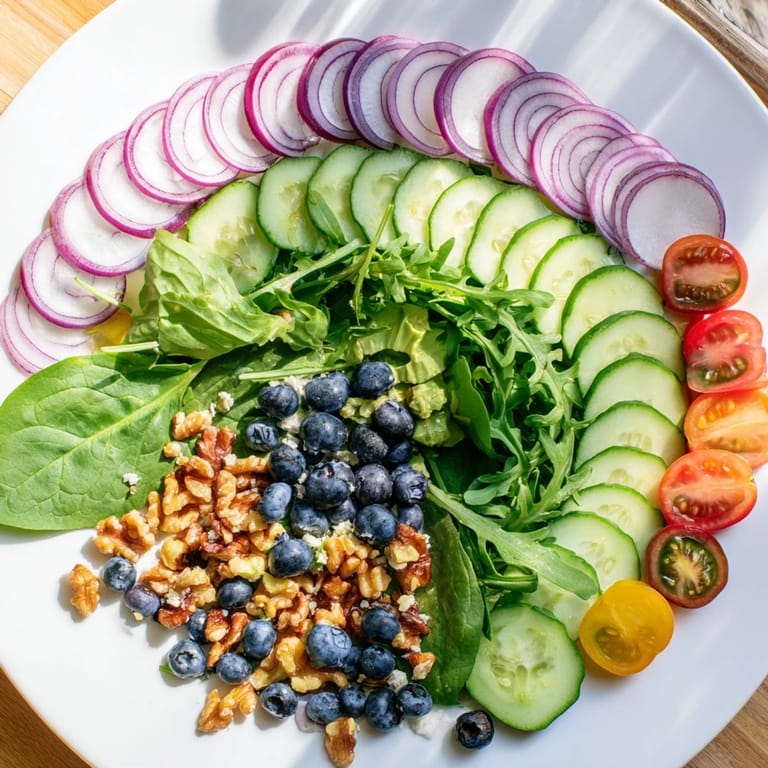
- Add cherry tomatoes in an expanding arc, then cucumber slices, then radishes, each section slightly larger than the last. Step back and look at what you've created—it should feel balanced, not rigid.
- Add subtle accents:
- Create a thin ring of red onion near the outer edge, slicing it so fine it catches the light. It's restraint that makes the arrangement sing.
- Nestle the stars:
- Tuck avocado slices and blueberries into the spiral strategically, treating them as jewels rather than fillers. Space them so they're visible and purposeful.
- Crown the arrangement:
- Scatter toasted walnuts and crumbled feta across the entire platter, letting them fall where they will with gentle randomness.
- Make your dressing:
- In a small bowl, whisk olive oil, lemon juice, honey, and mustard together until it emulsifies and thickens slightly. Taste and adjust salt and pepper—dressing is your last chance to balance everything.
- Finish with intention:
- Drizzle the dressing evenly over the platter just before serving, letting it pool in pockets and cling to leaves. The moment between drizzle and first bite is the real magic.
 Save
Save What I didn't expect was how this salad became a conversation starter, a small moment where people asked why I'd arranged it that way and whether I'd planned it or discovered it as I went. It reminded me that food isn't just about nourishment; sometimes it's about creating a pause in someone's day, a reason to notice something beautiful before tasting it.
The Power of Presentation
There's something almost meditative about arranging this salad carefully instead of just tossing everything into a bowl. As you place each ingredient, you begin to see the whole picture come together—the color contrasts pop more, the textures become visible as distinct elements rather than a blur. I've noticed that when people can see what they're about to eat, they chew slower and taste more. The spiral arrangement isn't fussy or pretentious; it's actually a practical way to ensure every forkful has balance, which is the whole point of eating well in the first place.
Swapping Ingredients Without Losing the Magic
The beauty of this salad is that it's forgiving if you need to improvise. Don't have blueberries? Pomegranate seeds work just as well and add a sharper jewel-like quality. Can't find good radishes? Thin slices of fennel bring similar crunch with a different flavor story. Goat cheese instead of feta? Absolutely—the tanginess shifts slightly but the concept holds. The spiral arrangement stays true even when you're working with what you have, which is how most weeknight cooking actually happens anyway.
Making It Your Own
This salad works best when you treat it as a starting point rather than a rigid formula. I've made versions with grilled chicken nestled into the spiral, added crispy chickpeas for plant-based protein, and once used thin ribbons of roasted beets for an entirely different color story. The Fibonacci principle is flexible—what matters is that the arrangement intentional and builds outward with rhythm. Trust your instincts about what tastes good together, and let the spiral do what it does best: make every element visible and accessible.
- If you're feeding people with allergies, prep nuts and cheese separately so they can be added selectively without contaminating the main dish.
- Leftover dressing keeps for three days and works beautifully on roasted vegetables or grain bowls.
- The salad can be partially prepped ahead—arrange greens and sturdy vegetables, then add avocado and soft items just before serving.
 Save
Save This salad taught me that sometimes the simplest moments of cooking—arranging colors, tasting a balanced dressing, watching someone's face light up—matter more than complexity or effort. It's proof that planning and intention can make ordinary vegetables feel extraordinary.
Recipe FAQs
- → How do I arrange the ingredients for the spiral?
Start with spinach leaves in a crescent shape as the innermost arc, then overlap arugula and continue adding ingredients in expanding arcs following the spiral ratio.
- → Can I substitute the feta cheese?
Yes, goat cheese or other crumbly cheeses can be used as a flavorful alternative to feta.
- → What dressing complements this layered salad?
A mixture of extra-virgin olive oil, lemon juice, honey, Dijon mustard, salt, and pepper provides a tangy and balanced dressing.
- → Are there any common allergens in this dish?
Yes, it contains dairy from the feta cheese, tree nuts from walnuts, and mustard in the dressing.
- → Can I add protein to make this more filling?
Grilled chicken or chickpeas can be added on top to increase protein content while maintaining freshness.